The panel “Responsibility of public oversight: how does PANA strengthen audit quality?”1 has now taken place. Renata Zielińska, the National Ombudsman for Statutory Auditors’ Rights at PIBR, and I represented the statutory audit profession on the panel. It was a highly charged discussion – and it could hardly have been otherwise. The problems concern not only procedures and indicators, but above all people: statutory auditors, their health, their families and trust in a profession to which many of us have devoted our entire working lives.
The format of the panel did not allow every thread to be developed. That is why I am sharing the data presented on the slides and discussing them in more detail. I hope they will mark the beginning of a real dialogue – one based on facts, on listening to each other’s arguments and on a readiness to assess the problems raised by the profession on their merits.
1. The Agency’s objectives measured by its own yardsticks
In the PANA Strategy for 2024–2027, the Agency set out objectives including the following: an average number of breaches close to the IFIAR averages, transparency, constructive dialogue with the market, and the development and greater competitiveness of the market2. I set these objectives against the available data:
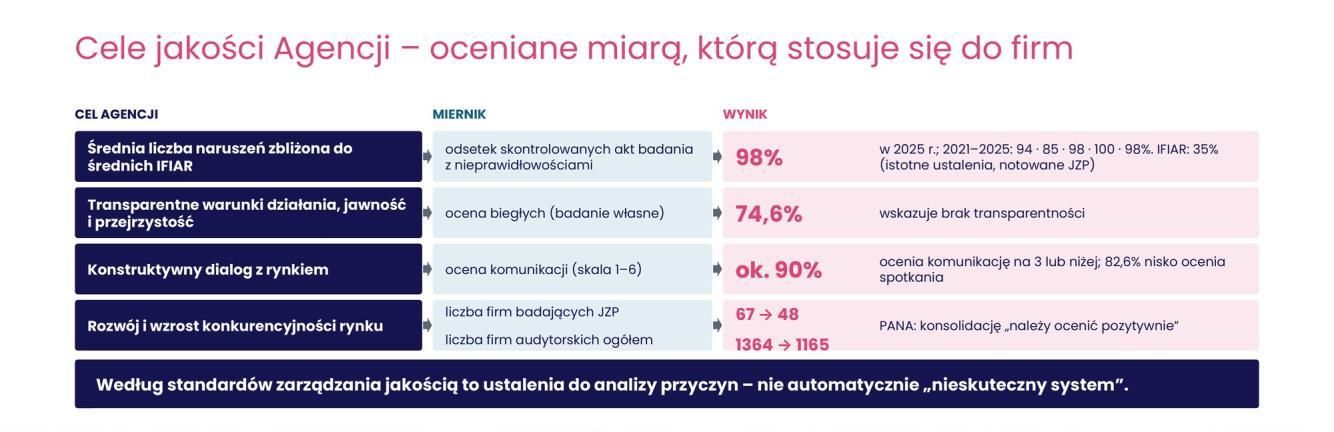
- An average number of breaches close to the IFIAR averages: deficiencies were found in 98% of the audit files inspected in 2025 (PIEs – 41 of 42, other entities – 225 of 229)3; in 2021–2025 the rate was 94%, 85%, 98%, 100% and 98%. IFIAR (Inspection Findings Survey 2025) reports at least one significant finding in 35% of inspected audits of listed PIEs in the six GPPC networks. These figures cannot be compared directly – the populations, the definitions of findings and the methodology differ – and the Agency has not specified a measure by which it assesses whether an objective worded in this way has been achieved. It is therefore hard to regard it as measurable in the sense of the SMART principle.
- Transparency: 74.6% of the respondents in my survey point to a lack of transparency in oversight.
- Constructive dialogue with the market: about 90% rate communication with PANA at 3 or lower on a scale of 1–6, and 82.6% give a low rating to the meetings held online.
- Development and competitiveness of the market: the number of audit firms auditing PIEs fell from 67 in 2021 to 48 in 2025 (–28%), and the total number of audit firms on the PANA list from 1,364 to 1,165 (–15%); since 2012 the number of firms has fallen by 539, or 32%4. PANA takes the view that the consolidation trends “should be assessed positively”5, even though the explanatory memorandum to the Act gave assurances that the new system would not restrict competition, including in the SME segment.
A high rate of deficiencies is important information, but it needs to be interpreted with care. Inspections are risk-based, so their results are not a representative measure of the quality of all audits in Poland. At firm level, findings from purposely selected files may point to weaknesses in the system of quality management, but they do not establish that the whole system is ineffective – moving from the files to the system requires an analysis of the causes, severity and pervasiveness of the shortcomings. This is required both by quality management methodology and by KSKJ 1Additional contextKSKJ 1 is the International Standard on Quality Management 1 (ISQM 1), adopted in Poland as a national standard by resolution of the PANA Council of 15 November 2022.; the inspection records I have analysed show, however, that in inspection practice this step is sometimes skipped. What is more, a finding very quickly becomes a breach.
The audited entities also bear the consequences of such generalisation. Business owners who know the context are understanding about it. Increasingly, however, we hear clients ask: “what is this assessment of your work all about?” – and behind that question lies a doubt as to whether the auditor and the opinion they have issued can be trusted. The negative signal therefore extends not only to the whole profession, but also to financial statements that have been audited properly. On top of this come the effects of people leaving the profession: some entities spend many weeks looking for an auditor willing to take on the audit, especially outside the large cities. There is also the question of how foreign business partners and investors will read this picture. A Polish statutory auditor applies the same International Standards on Auditing and works within the same EU regulations as auditors in the other EU member states. If the picture of their work is so different, it is worth asking whether the source of the difference is the quality of audits, or national arrangements and the model of oversight.
Improving quality is not about “finding someone to blame”
In my view, the communication of the oversight body is dominated by the language of breaches, deficiencies and sanctions, while references to cooperation, dialogue and trust in auditors appear only sporadically. Yet in quality management under ISO 9001:2015, a nonconformity does not end the assessment – it begins it: identifying the nonconformity → assessing its significance and causes → corrective action → verifying effectiveness (the PDCA cycle). The effectiveness of a system is shown not by the absence of nonconformities, but by whether the organisation identifies their causes and effectively prevents them. KSKJ 16 makes the same distinction, separating a weakness in the system from the conclusion that the system does not provide reasonable assurance that its objectives are achieved. In inspection practice, however, findings in individual files are used to conclude that the whole system is ineffective.
When a nonconformity is associated above all with a sanction, the incentive grows to protect oneself against inspection rather than to improve. My survey indicates that this risk has already materialised: 93.5% of respondents extend the scope of evidence beyond what is justified, solely out of fear of an inspection, and 94% believe that the oversight body values documentation more than the conduct of the audit (more on this in points 3 and 4). This is a picture of defensive auditing – carried out with a future inspector in mind, rather than the user of the financial statements.
PANA itself has described administrative penalties as “punitive and educational”, serving to prevent breaches in the future7. It is therefore worth asking how it assesses this preventive function: does it analyse the effectiveness of remedial action, the elimination of the causes of shortcomings and the improvement in the quality of subsequent audits? EU oversight bodies see sanctions as a tool for improving audit quality and declare a preference for a stricter sanctioning practice8. Punishment may be an instrument for enforcing accountability, but the severity of a sanction is not a measure of quality improvement. The results of my research indicate that harsher punitive measures lead to self-protective behaviour and withdrawal – defensive auditing instead of better auditing.
What do we measure, and what remains unseen?
The picture of the market lacks what statutory auditors actually achieve: errors detected and corrected before the financial statements are published, knowledge passed on to accountants, risks identified and reporting processes improved. The PANA Strategy envisages “supporting audit firms in improving their control procedures” through reports that draw attention to “significant and most frequently occurring deficiencies”9. Support thus comes down to pointing out what is wrong, while developing good practice remains the task of the firms themselves – their “own assessment of the quality of the services they provide” – including the smallest firms, without the methodological resources of the large networks. Yet an oversight body that sees hundreds of audit files could have unique knowledge of what works well – provided it is looking for “the good” as well.
The objectives and plans of inspections and the way inspectors’ performance is assessed may reward, above all, the finding of deficiencies. If periodic appraisal or pay is linked to their number, a focus on finding errors becomes systemic. Good practice then remains invisible, because it does not count towards the result of an inspection. The yardstick itself also becomes distorted. The number of findings stops telling us about the quality of audits and starts telling us about the effectiveness of the inspectors. It rises not because audits are getting worse, but because findings have become the measure of success. The number of deficiencies found in inspections can say something about audit quality only as long as it remains an observed indicator rather than a target. If it starts to serve as a measure of the effectiveness of oversight itself, the risk described by Goodhart’s law arises: the measure begins to shape the behaviour it was only meant to record10. On the oversight side, a fault-finding perspective becomes entrenched; on the auditors’ side, documenting for a future inspection rather than for the risks of the audit. Other oversight bodies, such as the UK’s FRC, publish examples of good practice alongside the most common shortcomings. If PANA’s reports included such an element, the objective of “supporting improvement” would gain real substance.
During the panel I used a comparison with school. A teacher who cares about a pupil’s progress does not just underline mistakes in red – they write in the margin how the work can be improved. The profession expects the same from the oversight body: alongside deficiencies, guidance and examples of what to aim for, and – where the inspector’s assessment differs from the auditor’s judgement – an indication of the specific requirement and the reasons why the interpretation adopted cannot be accepted. Only then does a finding become material to learn from, rather than just a verdict.
Is it worth becoming a statutory auditor?
The language of sanctions also matters for the future of the profession. Thanks to cooperation between universities and the professional self-regulatory body, exemptions from some of the examinations are opening a qualification route for successive cohorts of graduates, who will soon begin to enter the profession. They will need mentors – experienced auditors under whose guidance they will complete their training and from whom they will learn not only methodology but, above all, responsibility, professional judgement and professional courage. The future of Polish audit therefore depends not only on the number of new candidates, but also on whether they will have someone to learn from. Last year, final-year audit students at the Krakow University of Economics asked me directly: is it worth it? It is a choice about ambition, passion and … health. How is an experienced auditor who has been living with a sense of threat for years, and who faces long-running proceedings, to pass on pride in the profession to young people when they themselves wonder whether practising it is worth the personal cost? In 2026 alone (up to 31 August), another 94 people left the profession – and with everyone who leaves, a potential mentor is lost.
The oversight body should bring deficiencies to light, but it should not reduce the public image of the whole profession to deficiencies and sanctions alone. The position of the Ogólnopolskie Porozumienie Samorządów Zawodów Zaufania Publicznego (the national alliance of self-regulatory bodies of public trust professions), to which our chamber, PIBR, also belongs, speaks in a similar spirit:
responsibility is individual in nature and should be assessed on the basis of facts, and transferring it to the entire professional community is unacceptable11.
2. Why PANA was set up and what today’s data show
The explanatory memorandum to the 2019 Act (Sejm paper no. 348112) pointed to proceedings that were too rare, too lenient and too protracted. Today’s data:
- Frequency: in 2017, 194 of 273 closed cases (more than 70%) ended without a request for a penalty13, because soft instruments were used more often. Today the share of inspection reports recommending that proceedings be opened has risen from 21% (PIBR National Supervisory Committee, KKN, 2018–2019) to 81% (PANA report 2022). PANA does not publish the indicator for subsequent years. At the same time, the share of inspections in which deficiencies were found in the audit files, reaching 98–100%, may suggest that the scale of the problem has not fundamentally changed. This makes the discontinuation of the indicator all the more puzzling, especially in the context of transparency and the possibility of assessing PANA’s supervisory practice.
- Severity: according to the explanatory memorandum to the amendment of the Act, in the system before PANA was set up about 80% of penalties were admonitions, reprimands and fines of up to about PLN 4,000, and a ban on performing audit work was imposed 6 times in 2017 and only twice in 201814. Today Poland has the largest number of sanctions and administrative measures in the EU/EEA: 1,169 in 2021–2025 (CEAOB Enforcement Questionnaire)15. By comparison: Hungary 1,033, Spain 532, Germany 406, France 211, and at the bottom of the list the Netherlands with 1016. These are absolute numbers, and the countries differ in the size of their markets and their catalogues of measures, so this comparison shows scale, not a ranking of severity. In 2025, in the PIE segment, the number of reported sanctions and measures per firm auditing PIEs was 3.64 times higher in Poland than the indicator for all the EU/EEA countries covered by the comparison17.
Fig. 2. Total number of sanctions and administrative measures against statutory auditors and audit firms, 2021–2025 (selected EU/EEA countries). Source: CEAOB Enforcement Questionnaire, section A; selected countries (full list: 29 countries, the fewest – the Netherlands, 10).
- Length of proceedings: in 2017 the National Disciplinary Prosecutor closed 273 of 473 cases (58%). In 2025 PANA closed 116 of 434 proceedings (27%). According to my research, the average length of proceedings is about 4 years, but there are also cases lasting as long as 10 years.
These data raise the question of whether the change in the model of oversight has shifted the emphasis too far towards punishment. If deficiencies are found almost universally in the inspected sample, it is all the more important to distinguish their nature, severity and real consequences.
3. Fear arrived before the inspector
In my survey (N = 216)18:
- 97% fear an inspection even when the audit has been carried out properly,
- 93% of those who have never been inspected also fear it,
- 93.5% say they extend the scope of evidence beyond what is justified, solely out of fear of an inspection,
- the intensity of anxiety (on a scale of 1–5) averages 4.59 among those who have been inspected and 4.46 among those who have not. The difference did not reach statistical significance; this does not, however, demonstrate that the groups are equivalent. Nor was any statistically significant relationship between anxiety and length of experience found in the sample.
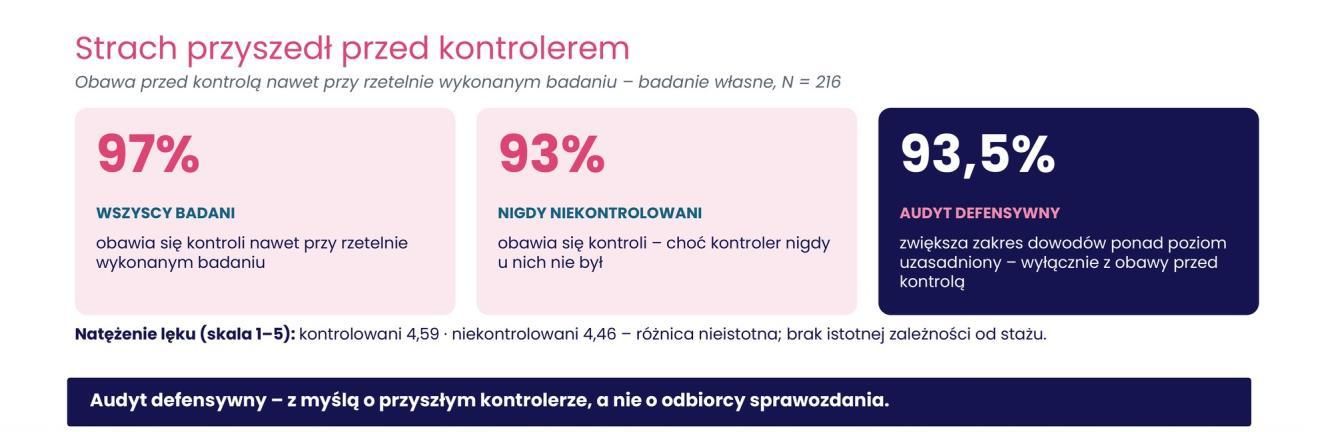
The results indicate that a high level of anxiety is not limited to those who have experienced an inspection themselves. The observed pattern is consistent with the hypothesis that the influence of oversight extends beyond the course of individual inspections. The co-occurrence of high anxiety with declared defensive behaviour raises the question of whether the additional documentation effort always translates into a real improvement in audit quality. In the survey, respondents often reported creating additional documentation with a future inspection in mind.
4. How auditors assess oversight
From the same survey:
- 76.6% disagree that PANA has an appropriate impact on protecting the public interest (53% strongly),
- 81.6% disagree that PANA has a positive impact on the stability and credibility of the market (58% strongly),
- 83.2% take a negative view of the transfer of proceedings concerning audits of non-PIE entities from PIBR to PANA (72% strongly),
- 84% point to ambiguous expectations on the part of the oversight body,
- 94% believe that the oversight body values documentation more than the conduct of the audit itself.
The last two results may indicate that, where supervisory expectations are perceived as ambiguous, documentation takes on particular importance in respondents’ eyes as a way of protecting themselves against a future inspection.
Fig. 4. Has oversight passed the test? Statutory auditors’ assessment of PANA’s activities – own survey, N=216. “Disagree” strongly: 72% (transfer of proceedings), 58% (impact on the market), 53% (public interest).
5. The psychological and family costs of regulatory pressure
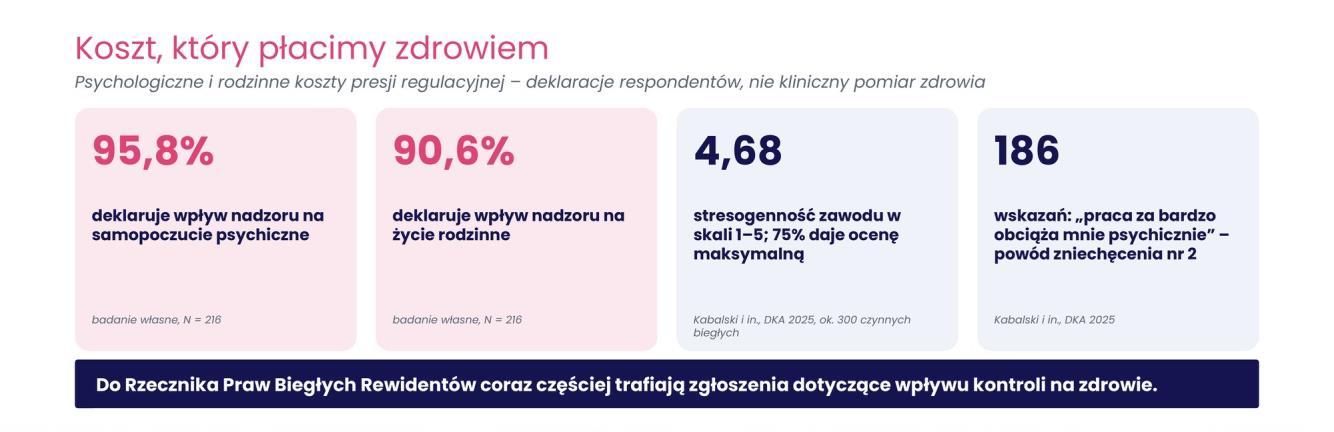
- 95.8% of respondents report that oversight affects their mental well-being, and 90.6% their family life (own survey, N = 216). These are respondents’ declarations, not a clinical measurement of health.
- The stressfulness of the profession is rated at 4.68 on a scale of 1–5, and 75% of respondents give the maximum score. “My work places too great a psychological burden on me” is the second most common reason for discouragement, cited 186 times (Kabalski et al., PIBR Annual Auditing Conference (DKA) 2025, about 300 practising auditors).
During the panel, the National Ombudsman for Statutory Auditors’ Rights at PIBR, Renata Zielińska, pointed out that the Ombudsman is increasingly receiving reports not only asking for help in the course of inspection and post-inspection proceedings, but also concerning the impact of inspections on auditors’ health.
6. Different research centres, different samples, a consistent picture
My results are not isolated:
- Ministry of Finance (September 2024, 744 auditors): 91% cite awareness of high penalties as one of the most difficult aspects of the profession (respondents pointed to penalties disproportionate to the offences, e.g. formal ones related to documentation requirements, and to the lack of dialogue between the oversight body and the profession)19.
- Voss, Kania, Pokrop (DKA 2024, N = 186; Rocznik Audytu i Rachunkowości [Audit and Accounting Yearbook] 2024, pp. 127–13820): more than 80% of respondents (150 people) cited heavy responsibility and penalties as the main reason for leaving and ceasing to practise the profession. The next reasons were the growth in documentation obligations and KSKJ requirements (118 people) and heavy pressure and working under stress (105 people).
- Kabalski et al. (University of Łódź, Wroclaw University of Economics and Business, DKA 2025, N >300): “too much pressure from PANA” is the most common reason for discouragement, cited 297 times. Among those not actively practising, less pressure from PANA is the most frequently cited condition for returning to the profession.
- My survey (N = 216): 97% fear an inspection even when the audit has been carried out properly, 84% point to ambiguous expectations on the part of the oversight body, 94% believe that the oversight body values documentation more than the conduct of the audit, and 82% experience stress related to inspections.
Four independent research teams, different samples and tools, and one of the studies published by the Agency’s own publishing house. Despite methodological differences, the results point to recurring problems related to regulatory pressure, professional liability and the conditions in which the profession is practised. This convergence justifies an in-depth analysis, but not treating the scope of all the studies as identical.
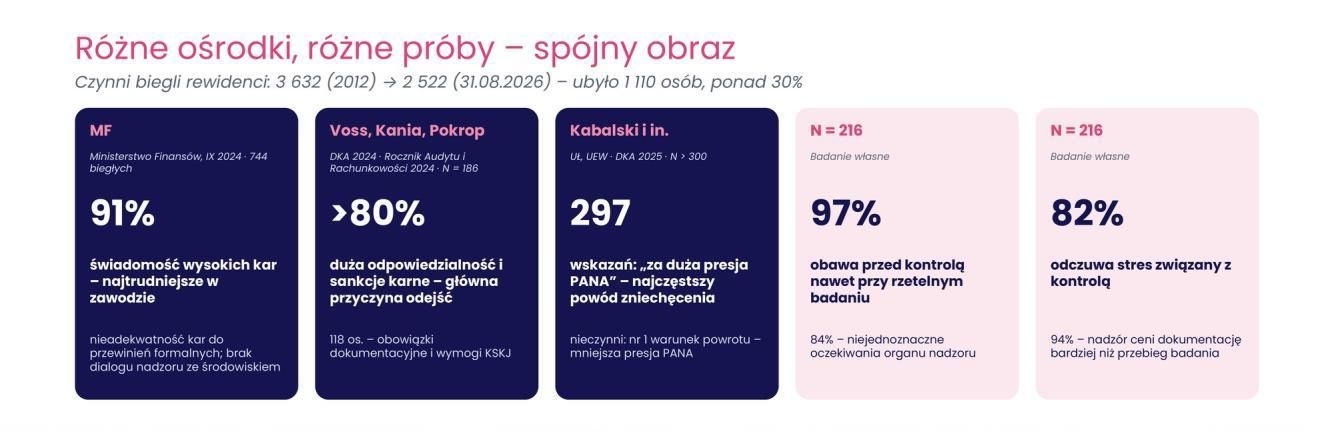
For context: according to PIBR data, the number of practising statutory auditors fell from 3,632 (2012) to 2,522 (31 August 2026), a decrease of 1,110 people. In 2026 (up to 31 August), 94 people left the profession21. The President of PANA cites retirement, among other things, as a cause of this situation22. Yet in a study published in the yearbook issued by PANA, co-authored by a representative of the Agency, the authors state that “every year people leave the profession whose departure is not always the result of retirement”, and more than 80% of respondents cited heavy responsibility and penalties as the main reason for leaving23. This alone does not make it possible to establish what share of the total fall in the number of practising auditors these factors account for. What is beyond dispute, however, is that statutory auditors state in surveys that they do not intend to devote their lives to an environment that takes more and more from them…
7. Can PANA apply scalable and proportionate supervisory measures today? Yes.
The starting point: six concepts in the inspection procedure
PANA’s inspection procedures use, in particular, six concepts describing successive stages of assessment: observation, preliminary findings, preliminary results, inspection findings, deficiencies and breaches. None of them has been defined – either in the Act or in the procedures – and no criteria have been given for distinguishing between them or for the conditions under which an inspector’s observations become a finding of a breach. Nor is this gradation reflected in the inspection documents. For each finding, the template inspection record provides two columns: “Description of the factual findings together with a description of the deficiencies found and their scope” and “Legal basis of the breaches”. In a single row of the record, a factual finding thus becomes an “deficiency found”, and that in turn becomes a “breach” of the provision cited – and this happens before any objections have been considered. The intermediate concepts that could separate an observation from an allegation therefore perform no protective function in the procedure, and in practice the terms “deficiency” and “breach” are used interchangeably.
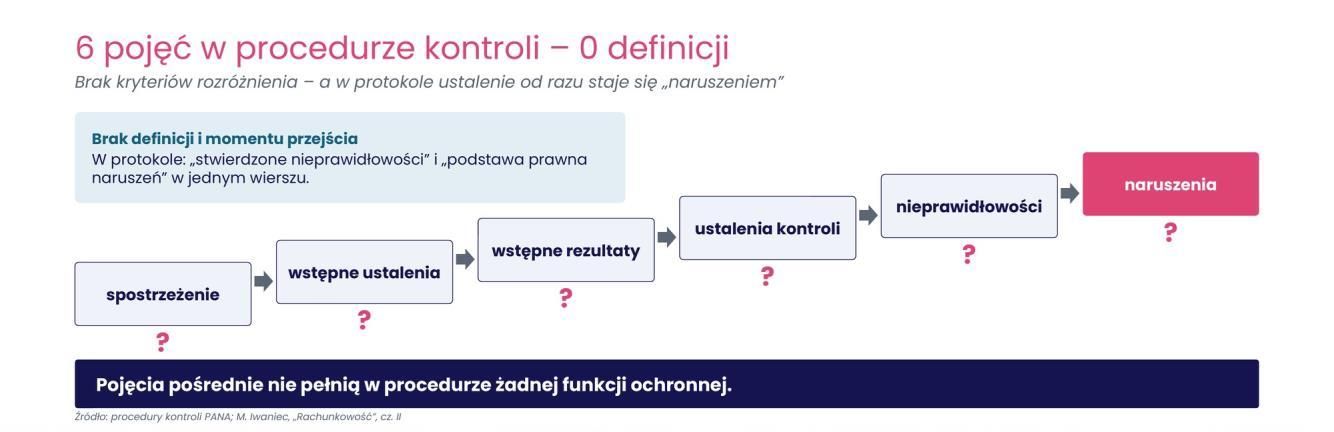
The current provisions of the Act and the standards provide a basis for a proportionate assessment. An inspection finding is not automatically a breach that justifies a sanction. The analysis should distinguish questions including the following:
- Has the objective of the standard been achieved – the standard as an objective-based norm? Each standard sets out an objective served by its requirements. The starting point is to assess whether the auditor has achieved that objective, not whether the file contains a document for every step. The standard on audit documentation (KSB 230) requires significant matters and significant professional judgements to be documented, not every matter considered or every judgement made. The standard states expressly (KSB 230 para. A7) that documenting everything is neither necessary nor practicable.
- Has a specific requirement been breached? The unmet requirement of the law or the standard must be identified, and the nature of the shortcoming explained. It must also be borne in mind that the national standards for practising the profession are not a source of universally binding law within the meaning of Article 87 of the Polish ConstitutionAdditional contextArticle 87 of the Polish Constitution sets out a closed list of the sources of universally binding law: the Constitution, statutes, ratified international agreements and regulations. Professional standards adopted by the profession or the oversight body are not on that list., but professional norms that set the benchmark of due diligence. They acquire legal significance through a statutory reference, which does not, however, change their nature: a standard based on principles and professional judgement does not turn into a catalogue of orders and prohibitions. If a requirement prescribes a specific action, failure to take it may constitute a shortcoming. If, however, it sets out an objective or an outcome and leaves the choice of procedures to the statutory auditor, the shortcoming is not the choice of a solution other than the one the inspector expected, but only the failure to achieve what the requirement actually requires. As the content of a blanket provision under which liability of a punitive nature arises, these requirements must be interpreted in the light of the constitutional principle of specificity.
- What are the nature, severity and consequences of the shortcoming? The assessment should cover, among other things, the impact on the sufficiency of evidence, the opinion and the users of the financial statements, and any significance of the finding for the system of quality management. The absence of an impact on the opinion does not mean that there has been no breach, but it should affect the supervisory measures applied.
- What response is proportionate? The Act on Statutory Auditors contains guidelines for determining penalties. For a statutory auditor (Article 160 of the Act), account is taken in particular of the gravity of the misconduct and its duration, the type and degree of the breach of duties, the degree of fault, the financial situation of the accused and the consequences of the misconduct for the injured party or for market participants. For an audit firm (Article 183(6) of the Act), account is taken in particular of the gravity of the breach and its duration, and the degree to which the firm contributed to it. The legislature itself therefore requires the response to be graduated, and the response should be proportionate to the nature and severity of the breach; in appropriate cases, remedial measures may take precedence.
Not every inspection finding justifies a sanction, and finding a breach requires a separate assessment of its severity, the circumstances and a proportionate response. Findings may also serve as a basis for discussion, recommendations and quality improvement, as I discuss in more detail in my articles in the monthly Rachunkowość (no. 7/2026 and 10/2026). And importantly, such solutions are applied in, for example, the United Kingdom, Spain and other countries24. Scalability requires the consistent use of existing tools, taking into account the specific requirements of the law.
8. The independence of inspectors
Trust in oversight depends not only on how it inspects, but also on who takes part in the inspection work. Combining roles related to inspection with activity in the same market may give rise to an actual or potential conflict of interest. Regulation 537/2014 and the Act on Statutory Auditors lay down independence requirements for those involved in inspections. The scope of the restrictions requires a distinction between the status of an inspector and that of an expert, between types of activity, and between inspections of audits of PIEs and of other entities. The principles of objectivity, avoiding conflicts of interest and confidentiality remain key to the credibility of oversight. The market is entitled to expect effective guarantees of the independence of those carrying out inspection work.
If a person who is active in the same regulated market and provides advisory services to other audit firms takes part in inspection work, there is a risk of building a competitive advantage, which the oversight system should not accept. The person carrying out the inspection gains access to information about competitors, and firms that use their advisory services may benefit from knowledge of the oversight body’s expectations that is not available to other market participants. It is hard to separate the knowledge gained while working for the authority from the knowledge presented in one’s advisory services. A comparison of PANA’s publicly available inspection plan with publicly available information on advisory activity shows that people taking part in inspection work provide advisory services to audit firms covered by that plan. In the course of my research, I received reports that people taking part in inspection work had sent offers to the clients of an audit firm under inspection, as well as offers of support during an inspection, justified by knowledge gained at the Agency. The Act provides for the participation of experts in inspections as an exceptional solution, “where the number of the Agency’s inspectors is insufficient” (Article 109 of the Act). Entrusting inspection work to people active in the same market should therefore be an exceptional situation, not the standard way of organising oversight. Accepting it as a permanent solution would be like a company treating permanent overtime as a normal model of employment: an emergency solution then becomes the system. The market is entitled to expect the oversight body to build its own independent team of inspectors.
Two paths of oversight
On the slide “Two paths of oversight” I compared two models of response to inspection findings. The first shows the course of inspections in Poland as critically assessed in my research: a focus on documenting individual steps, the risk of inspectors equating a finding with a breach, referring the case to proceedings, the need for the firm and/or the statutory auditor to defend their position for years, and, in certain cases, a sanction and its publication. This is a pattern of problems identified in practice, not a claim that every PANA inspection follows the same course or that proceedings and a penalty follow automatically in every case.
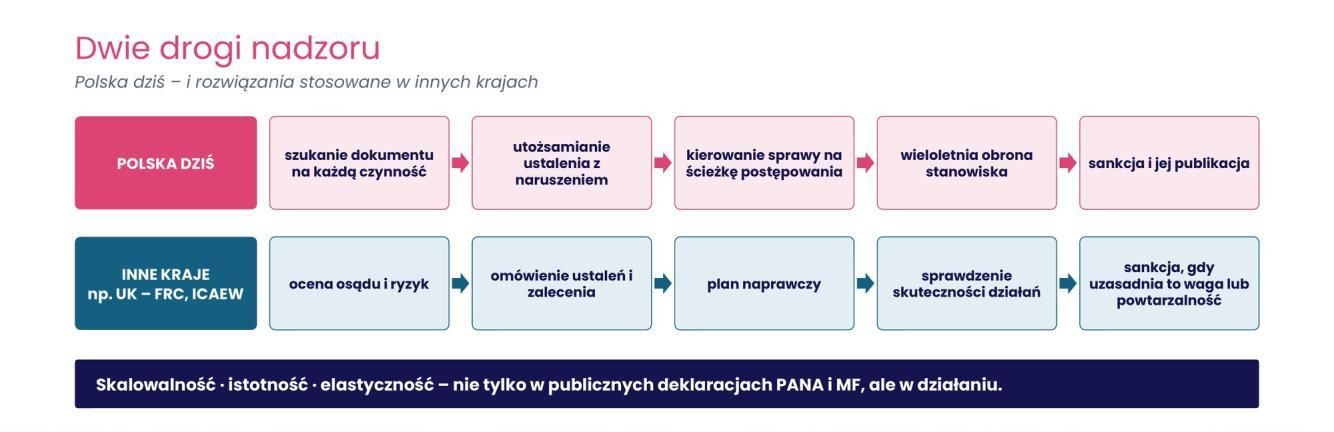
The second model, illustrated by supervisory solutions used in other European countries (e.g. in the United Kingdom – the FRC and ICAEW25), places the emphasis on assessing professional judgement and risks, discussing the findings with the inspected entity, making recommendations, preparing and implementing a remediation plan, and then checking the effectiveness of the action taken. Sanctions remain available in cases where the nature, severity or recurrence of breaches justifies their use. This is not, however, a uniform, mandatory sequence for all cases handled by oversight bodies; the instruments and procedures depend on the applicable regime and the circumstances.
The point of the comparison is therefore not to contrast “strict” and “lenient” oversight, but to ask what the centre of gravity of an inspection is: merely demonstrating a shortcoming and triggering a punitive response, or diagnosing its causes, assessing its significance for audit quality and achieving effective improvement. A sanction is a necessary instrument for protecting the public interest, but it should not replace risk analysis, professional judgement and proportionality. It is precisely at this level that the principles of scalability, materiality and flexibility should be applied in practice.
These data are not against oversight. They are for oversight that can be trusted. I hope for a change of approach: from a focus on sanctions towards proportionate assessment, dialogue and quality improvement. The solutions include a range of supervisory instruments, including remedial action and enforcement measures; this does not mean a single mandatory sequence for every case. The choice of response should take account of the nature, severity and circumstances of the shortcomings found. In the supervisory practice I have analysed, I see insufficient use of remedial instruments and dialogue.
Scalability, materiality and flexibility are not proposals invented by the profession for the purposes of this discussion. At the conference marking PANA’s 5th anniversary (23 May 2025), PANA’s Deputy President Dariusz Daniluk stated that the deregulation proposed by the Ministry of Finance is based precisely on these three principles: scalability, materiality and flexibility. The President of PANA, Jacek Gdański, pointed out that “an audit should always be of a high standard, regardless of who carries it out, and in the work of statutory auditors understanding the business matters more than ticking off successive items”26.
The profession can subscribe to these words. So let us move on from declarations. Let them be reflected in practice: in inspection records, in assessing professional judgement instead of looking for a document for every step, in distinguishing findings from breaches, and in the proportionality of sanctions.
I believe that the oversight body and the profession can work together in an ecosystem of partnership and mutual respect: with clear law, properly applied standards, real dialogue, an independent team of inspectors and a common goal – protecting public trust. Trust in oversight cannot be ordered or enforced through sanctions. It is built through legal predictability, procedural fairness, proportionality and transparency of action, and the protection of the rights of supervised entities.
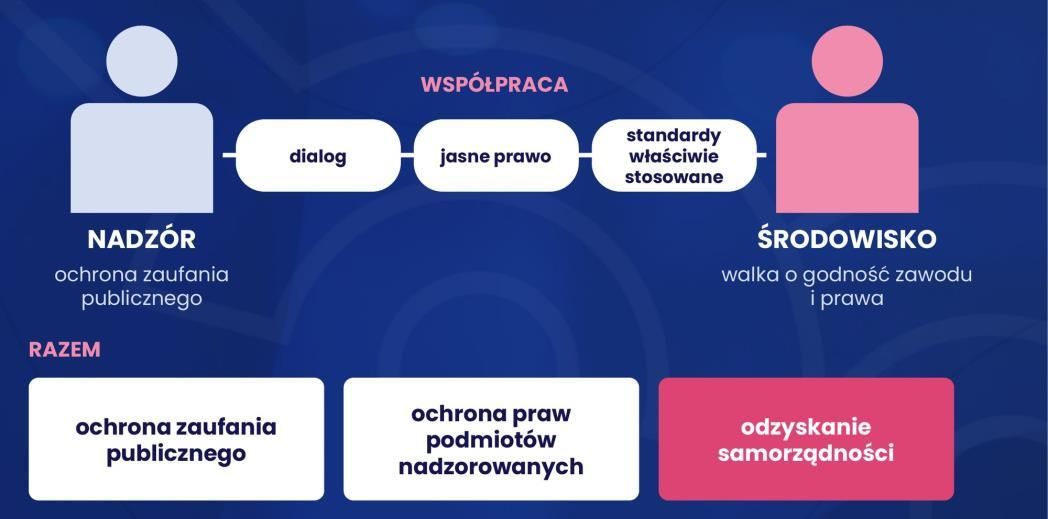
Improving quality requires accountability, but also trust. Oversight that can be trusted identifies shortcomings, but does not stop there. Finding a deficiency is the beginning, not the end, of the assessment: it requires examining the root causes, assessing the severity and pervasiveness of the shortcoming, choosing proportionate supervisory measures and verifying the effectiveness of remedial action – in other words, the same logic that KSKJ 1 requires of audit firms. The measure of the effectiveness of oversight is therefore not the number of deficiencies found, but whether similar shortcomings occur less and less often.
The precondition is real dialogue at the inspection stage. For inspections of PIE audits, Regulation 537/2014 (Article 26(8)) requires the findings and conclusions of inspections on which recommendations are based to be communicated to the inspected statutory auditor or audit firm and discussed with them before the inspection report is finalised; the same standard should apply to all inspections. The discussion should allow the inspected party to establish clearly which observations have been classified as findings and which as breaches, and on the basis of which requirement of a provision or standard, and to respond to that classification on its merits. Accounts from statutory auditors and the research of the National Ombudsman for Statutory Auditors’ Rights show, however, that practice is sometimes different.
Responding to an assessment on its merits also requires knowledge of the yardstick by which it is made and of the methodology used to arrive at it. The methodology for rating audit files has not been published, and this issue also came up in the discussion during the panel. If the criteria and the rating scale are not known to the inspected party, it is hard to expect them to respond to the rating included in the inspection report. Statutory auditors also point out that a rating scale for audit files without published criteria is perceived as stigmatising. A representative of PANA said during the panel that the methodology would be presented in 2027, and that the rating currently included in the report is used by the Agency for internal analysis. If so, the question arises why a rating intended for internal purposes is included in an official document served on the inspected party. And when asked about the consequences of the rating for a firm, the Agency replies that “a positive correlation should be expected between the worst ratings (i.e. 4) and the proposed follow-up action in the form of opening disciplinary investigations and/or administrative proceedings”. Taken together, the Agency’s statements create a dilemma: either the rating affects follow-up action, in which case it is not internal, or it does not, in which case there is no reason to include it in a document served on the inspected party.
The problem, however, concerns not only where and when the rating appears. The inspected party can lodge objections to the inspection record, but not to the inspection report. The rating of the files thus appears at a stage at which the inspected party has no procedural opportunity to respond to it27. As a result, it remains in the supervisory records as a kind of classification of the statutory auditor’s work that can be neither challenged nor even understood, since its criteria are not known. Nor has it been discussed with the inspected party. I discussed the question of the legal basis for adopting such a rating in an article in the monthly Rachunkowość, no. 10/2026 (https://rachunkowosc.com.pl/miary-oceny-osad-zawodowy-i-procedura-kontroli-firm-audytorskich-polska-praktyka-na-tle-rozwiazan-brytyjskich).
From the author
I thank the organisers, the panellists and all participants for their presence, their questions and their commitment. I invite you to continue the conversation and to work with us.
Further articles on public oversight of the audit market have been published in the monthly Rachunkowość, nos. 7/2026 and 10/2026.
In academic research, the response to research findings should be arguments and further research, not simply calling their value into question. Scholarly criticism is needed, because it makes it possible to improve methods and the interpretation of results. It should not, however, lead to marginalising a research voice because its findings depart from the established picture of how an institution works.
That is why a space for presenting research findings is so important, including findings that raise difficult questions about the effectiveness of oversight, its proportionality and its impact on the practice of the profession. For creating such a space and for making my publications openly available free of charge, I am particularly grateful to Professor Stanisław Hońko, President of the Main Board of the Accountants Association in Poland.
This is where Albert O. Hirschman’s concept of Exit, Voice, and Loyalty comes back. If a voice based on experience and empirical evidence finds no space for a substantive discussion, the risk grows that people with valuable knowledge and experience will withdraw from it – and ultimately from the profession. The risk is all the greater because we are already at that point … “exit”.
Speaking out is not a sign of disloyalty to the profession. On the contrary – it may be its fullest expression. I am all the more grateful for the creation of a space for this debate and for opening up access to publications. It is a concrete example of supporting dialogue, transparency and responsibility for the future of the profession.
Trust cannot be enforced – it is built through transparency, predictability and the perceived fairness of the procedure.
Hirschman showed, however, that exit is not the only path. A voice has strength when it is not a lone one. One statutory auditor in sanction proceedings is a “difficult case”; two hundred … auditors with documented experiences are a force that cannot be ignored. The position of the alliance of self-regulatory bodies of public trust professions reminds us that responsibility is individual – but the defence of the rights and dignity of the profession must be shared!
There are more than 2,500 of us statutory auditors actively practising the profession, and almost 5,000 people holding the title of statutory auditor. Each of these groups can contribute something that no other can replace. Practising auditors – experience of current inspections and proceedings. Those who have suspended or ended their practice – knowledge of why they left and what might persuade them to return. Senior members of the profession – the memory of how its authority was built, and experience that can support younger colleagues. If even some of us speak out together, “exit” will not be the only answer left to us. Get involved in our work!
With warm wishes to the whole statutory audit community – Dr Monika Iwaniec
The Foundation for the Protection of the Rights – Ad Legem
I would like to take this opportunity to announce the establishment of the Foundation for the Protection of the Rights – Ad Legem. It grew out of a need I have seen for years in conversations with statutory auditors: there is a lack of real support for people who are left on their own in their dealings with the oversight body, especially auditors and audit firms in the SME market. Smaller firms do not have the legal, methodological or organisational resources of the large networks, and it is they who feel the effects of inspections, proceedings and sanctions most strongly.
The foundation aims to fill this gap through expert reports and opinions, support in cases concerning the rights of supervised entities, systemic action, a voice for the profession in public debate, and psychological workshops to help people cope with the stress and strain that, as research shows, the great majority of the statutory auditors surveyed report today. We are also setting up a Programme Council with representatives of academia and practice. Everyone can help as far as they are able:
Share your experience. Describe the course of an inspection or proceedings – in confidence and anonymously. The cases we collect become evidence in discussions with, among others, the oversight body, the legislature and public authorities.
Take part in research. Every completed questionnaire turns individual impressions into data that cannot be dismissed in a single sentence.
Share your knowledge. If you have experience of proceedings, of audit methodology, or of law and psychology, join the foundation’s group of experts.
Pass it on. Share this text with a colleague who is facing an inspection alone – often the first help is knowing that they are not the only one.
Support us financially. Donations make it possible to fund expert reports, support in proceedings, research and psychological workshops for auditors.
What we put in together will come back to the whole profession. Together we can do more.
PL35 1020 3466 0000 9302 0235 9776
PKO Bank Polski
- Recipient
- Foundation for the Protection of the Rights – Ad Legem
- Recipient address
- ul. Myśliwska 57/5E, 30-718 Kraków
- Transfer title
- Donation for statutory purposes
- BIC/SWIFT
- BPKOPLPW
Notes
-
The text expresses the author’s personal conclusions as a researcher and does not represent the position of PIBR or of the conference organisers. ↩
-
Strategy of the Polish Agency for Audit Oversight for 2024–2027, Warsaw, September 2024. ↩
-
PANA report on monitoring the market for services provided by statutory auditors and audit firms for 2025. ↩
-
PANA monitoring report (…) for 2021; PANA monitoring report (…) for 2025. ↩
-
PANA monitoring report (…) for 2025, p. 15. ↩
-
National Standard on Quality Control 1 in the wording of the International Standard on Quality Management, Annex 1 to Resolution No. 38/I/2022 of the Council of the Polish Agency for Audit Oversight of 15 November 2022. ↩
-
PANA annual report for 2021, p. 23. ↩
-
CEAOB, Report on the 2022 CEAOB Enforcement Questionnaire, part G.5. ↩
-
PANA Strategy (…), p. 10. ↩
-
“Any observed statistical regularity will tend to collapse once pressure is placed upon it for control purposes”. ↩
-
On 3 July 2026, the members of the national alliance of self-regulatory bodies of public trust professions (Ogólnopolskie Porozumienie Samorządów Zawodów Zaufania Publicznego), to which the Polish Chamber of Statutory Auditors belongs, adopted a position on the safety of people practising public trust professions and on public trust in those professions, https://www.pibr.org.pl/pl/aktualnosci/2710,Stanowisko-Ogolnopolskiego-Porozumienia-Samorzadow-Zawodow-Zaufania-Publicznego ↩
-
https://www.senat.gov.pl/download/gfx/senat/pl/senatposiedzeniatematy/4457/drukisejmowe/3481.pdf ↩
-
https://pana.gov.pl/wp-content/uploads/2023/05/PANA_Sprawozdanie-roczne_2022.pdf#page=31 ↩
-
https://www.senat.gov.pl/download/gfx/senat/pl/senatposiedzeniatematy/4457/drukisejmowe/3481.pdf ↩
-
The sum of sanctions and administrative measures in categories A1–A7 of the CEAOB reports (in the report for 2022 these were categories B1–B7) relating to the ARD provisions (Directive 2006/43/EC and Regulation (EU) No 537/2014) in 2021–2025. The number of sanctions is not the same as the number of proceedings. ↩
-
Liechtenstein reported no sanctions or administrative measures in the period analysed, but did not submit data to the CEAOB until 2022. Because the data are not fully comparable, the total number of sanctions and administrative measures reported by the Netherlands was taken as a more representative point of reference. ↩
-
The indicator is illustrative. Countries differ in their catalogues of sanctions and measures, their reporting rules, their models of oversight and their market structures, and the CEAOB data are not fully harmonised. ↩
-
The survey was carried out in October–December 2025. The link to the questionnaire was sent to auditors by PIBR and shared on social media. Every statutory auditor could take part in the survey. N=216. ↩
-
Ministry of Finance, Department of Public Expenditure Efficiency and Accounting, Dostęp do zawodu biegłego rewidenta, Wyniki badania ankietowego [Access to the statutory auditor profession: survey results], Warsaw, September 2024, pp. 30–31. ↩
-
G. Voss, D. Kania, K. Pokrop, Ocena satysfakcji zawodowej biegłych rewidentów – wyniki badania ankietowego [Assessing statutory auditors’ job satisfaction: survey results], Rocznik Audytu i Rachunkowości [Audit and Accounting Yearbook] 2024. ↩
-
Removal from the register of statutory auditors kept by PIBR. ↩
-
J. Gdański, Polski system nadzoru audytowego działa w interesie publicznym [The Polish audit oversight system works in the public interest], Rachunkowość 9/2026, quote: “This is a huge oversimplification, which ignores the fact that in reality a significant proportion of the people applying to be removed from the register have reached retirement age” – a response to the phenomena identified and described by the author in the article Czy system nadzoru wygasza polski audyt i kto wkrótce zbada sprawozdanie finansowe mniejszej firmy? – artykuł dyskusyjny [Is the oversight system winding down audit in Poland, and who will soon audit the financial statements of a smaller firm? – a discussion article], Rachunkowość 7/2026. ↩
-
G. Voss, (…), p. 132. ↩
-
Based on an analysis of the CEAOB Enforcement Questionnaire regarding the use of so-called soft measures by EU countries. In none of the years 2021–2025 did Poland report a single measure in this category. The post-inspection recommendations issued by PANA (Article 121(1)(1) of the Act on Statutory Auditors) do not perform this function. ↩
-
Because of the maturity of the UK market and its oversight, the FRC’s solutions are often cited as a point of reference for other authorities. ↩
-
https://pana.gov.pl/w-piatek-23-maja-odbyla-sie-konferencja-jubileuszowa-z-okazji-5-lecia-polskiej-agencji-nadzoru-audytowego/ ↩
-
Specific legal solutions are described in a monograph scheduled for publication at the end of 2026. ↩